Friday, May 23, 2014

Walking tour of Uzès

On Friday, May 23rd we went to the local tourist office and collected two mobile phone-like systems with headphones to facilitate an audio tour of Uzès.  The tour took us about three hours (fortunately not involving the "S.S. Minnow") and significantly increased our knowledge of our home town in France.  The map below highlights our path (black dotted line) and some points of interest:


Being an engineer, and supporting the KISS (keep it simple stupid) principle, Andrew references the historic centre of Uzès in relation to the "ring road" (which is actually five roads operating as a one-way anti-clockwise circuit), and the "pan handle" (Esplanade separated by dual carriageway Avenue de la Libération).  These two features are highlighted in red on the map above.  With our apartment (green dot) located close to the centre of the circle, everything is referenced via the "clock face" direction system, or relative to the west-facing Esplanade.  Other family members humour him with these systems, but he is confident several would go missing without them. (Ed (aka Elle): most - or all - of the other family members don't comprehend the system, so the fact that none have been lost (for very long, anyway), is in no way due to the system.)
The tour commenced at the 12 o’clock position on the circle at the Tourist Office, and headed south down Rue Jacques D’Uzès towards our apartment.  The first point of interest (not mentioned on the audio guide) was the following car.  Terracotta pots made by this company are found throughout Uzès and the surrounding region. 


The first official point of interest was one of the buildings immediately opposite our apartment.  The decorative windows and turret were mentioned as significant architectural features: and to think we look out at them every day from our bedroom window.

The next feature was the cloisters beneath the cafe which we look down on every day.  What a shame their coffee is not to the same standard as their history and architecture.

The next two photos show outside and inside images of a famous old building (Hôtel Verdier-Allut) in nearby Rue de la Republic, where the Christofides family (our new friends and fellow travellers from Camberwell) are currently residing.  The building was described as "a beautiful private mansion from the renaissance era, with decorative mouldings, mullion doors and Henri II style windows".  It provides a good example of a building in an old city that you may walk past every day without realising it had a very impressive history.  The lesson is to look up, to look in, and to do some research.


The tour then moved on to the spiritual centre of Uzès, the Place aux Herbes, marked as the blue rectangle on the map.  It was satisfying to learn more about several notable buildings and the undercroft areas, in addition to what the Place is best known for – its plane trees, fountain, and surrounding cafés.


From here we walked west to view the Esplanade (including the WWI memorial), and the nearby protestant church, where we learnt that Uzès was a very significant protestant city in the 16th century religious wars, during which many of the city’s churches were destroyed.  Also in this area are several buildings which were home to a thriving silk spinning industry in the 18th century.  Uzès specialised in silk stocking production, with silkworm breeding and silk production, as well as garment manufacture, carried out locally.

Coming back to the ring road, we then walked passed Eglise St Etienne (orange dot).  It was built in 1767, on the site of another church destroyed during the religious wars.  This church has been somewhat of an enigma to us, as it is an impressive structure that we have a view of from top bedroom, but to date the solitary entrance door has never been open when we have tried it. 


Behind the church we were led to the house of Charles Gide, a leading French economist in the late 19th century, and famous son of Uzès.  Wikipedia lists him as a “champion of the cooperative movement”, so he would be proud to see the numerous agriculture cooperatives still in operation around Uzès, and France more generally.  The Gide family name is commonly seen or heard in Uzès, with Charles’ nephew Andre also being famous – in his case as an author and winner of the Nobel Prize for Literature in 1947.
At the 6 o’clock position on the circle we noted L’Hôpital Général (yellow dot) which was built between 1749 and 1769 as part of a drive to improve public health.  At the same time the city ramparts were destroyed, and a cemetery and slaughterhouse were relocated outside the old (former) walls, which are the location of today's ring road.

We then turned left back into the heart of the old city.  Walking inside the ring road is generally very pleasant, as although cars can and do come in, they are limited to certain streets, and are very modest in number (generally shop owners, tradesmen, and parents doing school drop off and pick up).  We only require an occasional "Attention, la voiture!" or, if Xavier is doing the warning, a loud and urgent "Car!"

Along Rue Paul Foussat we noted some very colourful metalwork which took our fancy (Elle was most impressed with the surprising comfort of the chair).


We then continued north via Rue Port Royal, past the entrance to the Jardin Medieval (about which we will blog separately), and through several other beautiful streets.


We then headed east to the 3 o’clock position on the ring road to Cathédrale St Théodorit (blue dot), notable for its impressive ironwork (a key Uzès skill in days past) and the large, well-maintained organ.

Alongside the Cathederal is the Tour Fénestrelle, so named because of its "windows", and often referred to as a mini Leaning Tower.  (It is T4 on the map above.) It is the smallest but prettiest of the famous four medieval towers of Uzès; the others are the Belmonde Tower (T1 above - in the Duche D’Uzès), the Bishop’s Tower (T2), and the King’s Tower (T3) (both in the Jardin Medieval).
Next stops, not far away, were the old Bishopric (now Municipal Museum) and the Hôtel Du Baron De Castille (with its impressive columns).


We then headed back towards the centre of the clock, noting several lovely streets and buildings, including the Hôtel des Monnaies (where bishops minted coins) and the Hôtel Chambon De La Tour (which now houses a luxury hotel, and Table D’Uzès, one of the very nice restaurants where we have had dinner ... to be discussed in another blog post).


The tour concluded at the official centre of Uzès, Place du Duché, home to Le Duché D’Uzès (Duke’s Palace) and the Hôtel De Ville.


Thursday, May 22, 2014

Fun with Pippi and Helen – featuring Trash and Treasure, Bonbons, Saint-Rémy-de-Provence, the Pont du Gard, and crêpes

You may recall that Elle’s Mum (Betty or “Pippi” – her grandmother name) and Betty’s sister, Helen, arrived in Uzès just in time to join us for Elle’s birthday dinner on Friday, May 16.

Saturday
Pippi and Helen had one day of overlap with Kate, which included a trip to the Uzès Saturday market,


some sun-soaking on the terrace,


and then a lovely dinner for Elle, Kate, Pippi and Helen at Le Comptoir du 7.


Sunday
On Sunday morning, we sadly farewelled Kate, and Andrew followed a now well-worn route to Avignon TGV station to drop her off to begin her journey back to Phnom Penh. 

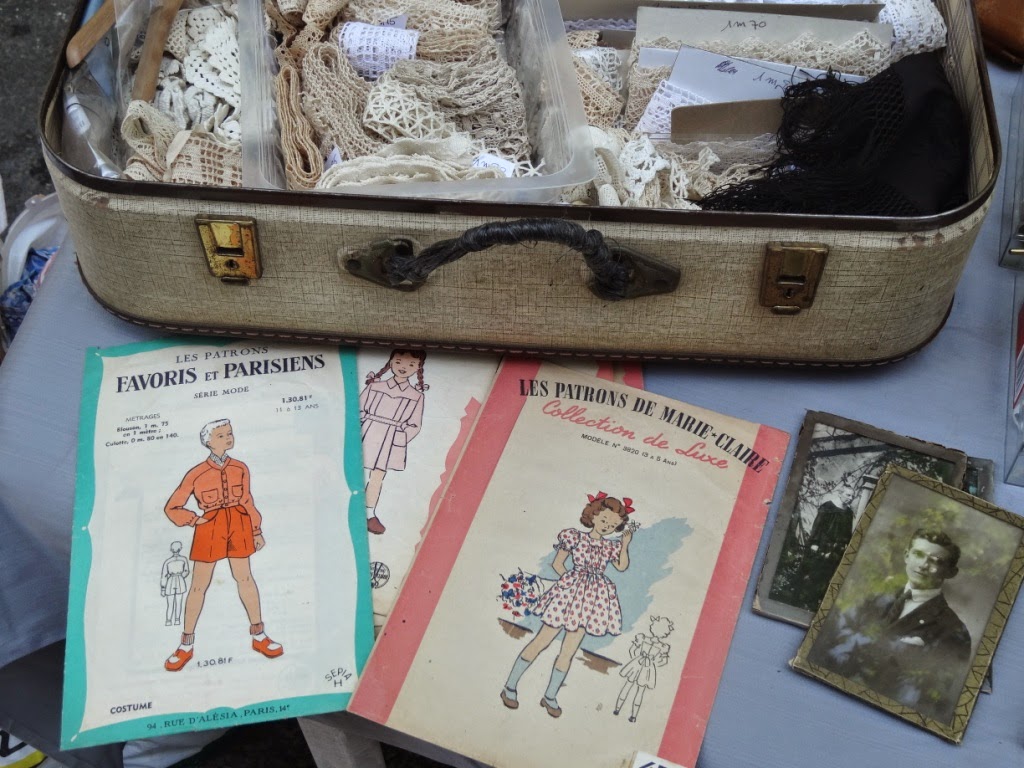
The route from our apartment in the (essentially pedestrian) medieval centre of town, to the car park just outside the centre, was densely packed with a very extensive brocante market.
We disparaged this as “Trash and Treasure”, with the emphasis on the former.  However, walking through with Kate on their way out, Xavier did spot a few cars he liked the look of...  and so did Pippi.  No sooner had she mounted the three flights of stairs to our apartment, than she turned around and went back down them, accompanied by Xavier, and, they returned together a short time later with this Treasure!


You can see the point of grandparents, right?!

Somewhat chastened, Andrew and I ventured out, ostensibly to pick up some fresh supplies for lunch, and we soon found some treasures too.


Swayed by the charms of their grandchildren/great-niece and nephews, Pippi and Helen were persuaded that their afternoon adventure should be a trip to the Musée de Bonbon, but that local landmark deserves a post of its own.

Monday
Monday, a routinely quiet day in Uzes, we set out to see Saint-Rémy-de-Provence.  Of course, it was quiet on a Monday too, with many local shops and cafes closed, but we stopped to take note of the birth-place of Nostradamus, and we were charmed by the little streets of its centre.


We took lunch at Crêperie Lou Planet, and Andrew declared his galette to be the best he’s ever had.


We all, but particularly Xavier, were entertained by the activities of a work crew, which very efficiently erected three new lamp-posts while we ate.


The car journey to and from was enlivened by Pippi and Helen teaching Xavier the song “You are my sunshine”.

Tuesday
A visit to the Pont du Gard, another local landmark that warrants - and will get - a post of its own.
Wednesday
We spent a low-key day in Uzes, including a trip to the Wednesday (mainly produce) market.
In the evening, we enjoying an aperitif with Philippe and Annick, the hosts of Pippi and Helen’s accommodation, La Maison Rouge.


Wednesday evening was Pippi and Helen’s final evening in Uzes, and we enjoyed a final meal together, with the venue chose by the children - our local favourite crêperie, La Bolée.


Bright and early Thursday morning, Andrew set out yet again for the Avignon TGV station, with Pippi and Helen heading to Milan to begin the Italian leg of their European adventure.